
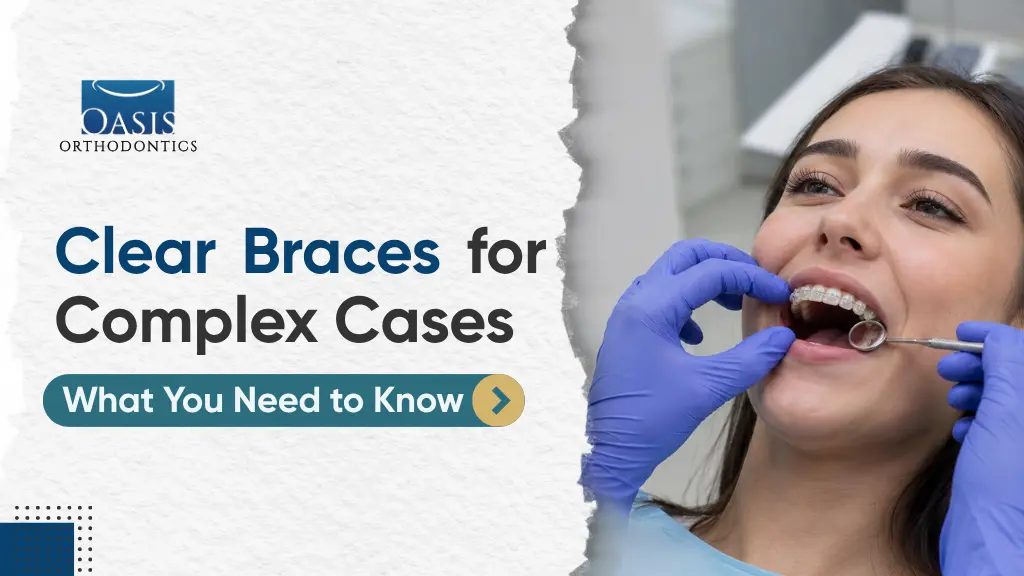
Patients with complex orthodontic needs are frequently told that clear braces are not strong enough for their case and that metal is the only real option.
For most complex cases, clear ceramic braces work just as effectively as metal. The bracket-and-wire mechanism is identical regardless of bracket material, and ceramic brackets are compatible with the same tools used for complex treatment including elastics, expanders, and temporary anchorage devices. The cases that genuinely require metal brackets are more specific and less common than most patients expect.
What follows covers what makes a case complex, how clear braces handle those problems, where the real limitations sit, and what determines whether clear braces are a genuine option for your situation.
What Makes an Orthodontic Problem Complex
Complexity in orthodontics is a clinical assessment, not a visual one. Two patients whose smiles look equally crowded can have very different treatment requirements depending on the underlying bite relationship, jaw structure, and degree of movement needed.
Problems commonly described as complex include severe crowding where teeth have insufficient space and need significant repositioning, significant bite issues including deep overbites, underbites, crossbites, and open bites, cases requiring tooth extraction to create space for movement, cases with previous orthodontic treatment that has relapsed, and teeth requiring substantial rotational movement or vertical correction.
The severity of each of these factors determines treatment complexity, and clinical assessment through X-rays, photographs, and bite measurements is what accurately classifies each case.
How Clear Braces Handle Complex Cases
Clear braces use tooth-colored ceramic brackets bonded to each tooth, connected by an archwire that applies controlled force to shift teeth into position. The biological process of bone remodeling that allows teeth to move is the same regardless of whether the bracket is ceramic or stainless steel. Bone remodels in response to force, not to bracket material.
For complex bite correction, clear braces are fully compatible with the same auxiliary tools used alongside metal braces. Class II elastics correct overbites by applying force between the upper and lower arches. Class III elastics address underbites through the same principle. Palatal expanders widen the upper jaw to create space. Temporary anchorage devices, small titanium screws placed in the jawbone to act as fixed anchor points, can be used with ceramic brackets for cases requiring precise force direction over long distances. None of these tools are restricted to metal braces.
Severe crowding that requires extractions is also manageable with clear braces. Once space is created, the archwire and brackets guide teeth into their new positions using the same mechanics as metal, with no functional difference from the bracket material alone.
Where Ceramic Brackets Have a Clinical Advantage Over Aligners
Patients comparing clear options often choose between ceramic braces and clear aligners. For complex cases, ceramic braces consistently outperform aligners.
Removable aligners depend on patient compliance and are worn for only 20 to 22 hours per day. Fixed ceramic brackets apply continuous force around the clock. For cases requiring significant tooth movement, substantial rotation, or vertical correction, continuous force produces more reliable and predictable results.
Ceramic braces also provide more precise directional control than aligners for complex bite corrections. Bite issues involving both upper and lower arch coordination, like significant overbites and underbites, respond better to fixed appliances where the orthodontist has direct control over the force applied at every bracket.
The Honest Limitations of Clear Braces
Clear braces handle most complex cases effectively, but ceramic brackets do have specific limitations worth understanding.
Ceramic is more brittle than stainless steel under sustained high force. For cases requiring very heavy bracket forces across a long treatment period, particularly deep bite corrections where the lower teeth risk contacting and chipping upper ceramic brackets, some orthodontists prefer metal brackets on the lower arch while keeping ceramic on the upper. The visual result still achieves the discreet appearance patients want, since the lower brackets are less visible when speaking.
Wire friction is a second consideration. Standard ceramic brackets have a slightly rougher surface than metal at a microscopic level, which can create marginally more friction between the bracket and the wire as teeth slide along it. Modern bracket designs have reduced this significantly, and low-friction ceramic bracket systems are widely available. The clinical impact for most patients is minimal, but in very complex cases involving long-distance tooth movement, an orthodontist may factor this in.
Severe skeletal problems in adults, where the jaw bones themselves are substantially misaligned rather than just the teeth, may require surgical orthodontics alongside braces regardless of bracket type. Clear braces remain a viable option for the orthodontic component of a combined plan, but the skeletal component cannot be addressed through orthodontic force alone.
Radiance Brackets and High-Clarity Options
Not all ceramic brackets are the same. Standard polycrystalline ceramic brackets offer good aesthetics and adequate strength for most cases. Radiance brackets use a monocrystalline sapphire material, optically clearer, more resistant to staining, and stronger than standard ceramic. For patients with more demanding cases who want the clearest possible bracket appearance, high-clarity options like Radiance offer both the aesthetic benefit and improved durability.
The bracket material also does not interfere with MRI imaging, unlike some metal systems, which matters for patients who may need medical imaging during the course of a treatment running 18 to 36 months.
What Actually Determines Whether Clear Braces Are Right for You
Bracket material is not what determines whether your case can be treated with clear braces. Case complexity is determined by the degree and direction of tooth movement required, the condition of the gums and supporting bone, patient age, and whether additional appliances are needed alongside the braces. All of those factors apply equally to ceramic and metal brackets.
The clinical evaluation answers which approach best fits your case. For the majority of patients presenting with complex problems, clear braces are on the table. For a smaller subset involving very high sustained forces or specific bite mechanics, a hybrid approach or full metal bracket system may be recommended. Your orthodontist can tell you clearly which situation applies to your case after examining the full clinical picture.
Frequently Asked Questions
Can clear braces fix severe crowding? Yes. Severe crowding is treated by repositioning teeth using archwire force, which works the same way with ceramic and metal brackets. For cases requiring extractions to create space, clear braces manage the subsequent tooth movement effectively.
Can clear braces correct a deep overbite? Most deep overbite cases can be managed with clear ceramic braces, often with the addition of elastics or bite blocks. For very deep bites where lower teeth risk chipping upper brackets, some orthodontists place metal on the lower arch and ceramic on the upper to protect the brackets while maintaining aesthetics.
Are clear braces slower than metal for complex cases? For most cases, treatment duration depends on case complexity rather than bracket material. Modern ceramic brackets have reduced the friction gap with metal significantly. Extremely complex cases may show a marginal speed advantage with metal, but the difference for most patients is not clinically significant.
Can clear braces be used with elastics and other appliances? Yes. Ceramic brackets are fully compatible with elastics, temporary anchorage devices, expanders, and other auxiliary appliances used in complex treatment plans.
Do clear braces cost more than metal for complex cases? Ceramic brackets typically cost more than metal brackets regardless of case complexity. The exact difference varies by practice and case requirements. Flexible payment plans are available to make either option accessible.
Get an Honest Assessment of Your Options
Most patients asking whether their case is too complex for clear braces find that it is not. The cases that genuinely require metal brackets are specific and less common than the assumption suggests.
At Oasis Orthodontics in Markham, Dr. Khushee Sharma-Fung personally reviews every case, assesses the full clinical picture, and gives you a direct answer on whether clear braces are appropriate for your specific situation. Book your consultation at Oasis Orthodontics and find out exactly what your treatment involves and which options are genuinely available to you.