
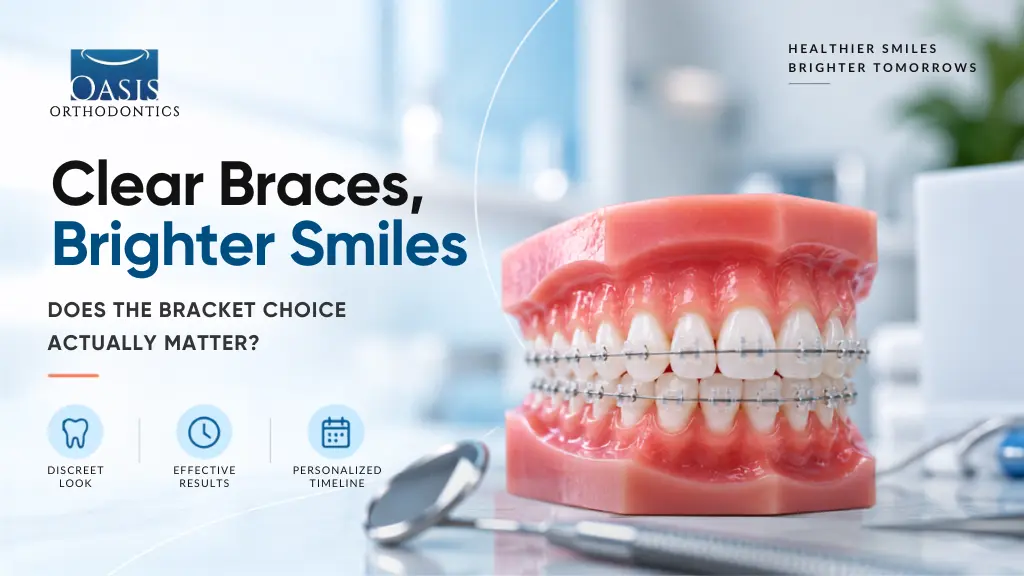
Many patients assume choosing clear braces automatically means a longer treatment. The bracket you pick is rarely the main thing driving your timeline.
Usually, no. For most patients with comparable cases, clear ceramic braces and metal braces take roughly the same amount of time. A small difference does exist in specific situations, but it comes from how the bracket material interacts with the wire, not from any fundamental difference in how the two systems work.
Knowing when the difference matters and when it does not helps patients make an informed choice rather than avoiding ceramic braces based on an outdated assumption.
How Both Systems Work in a Similar Way
Clear braces and metal braces use a very similar approach. Brackets attach to each tooth, a wire runs through them, and gentle pressure from the wire gradually shifts teeth into position.
The bracket material does not fundamentally change how the treatment works. Whether the bracket is ceramic or metal, the wire does much the same job. Treatment times tend to be similar because the pressure moving your teeth works in largely the same way either way.
The distinction comes down to two characteristics of ceramic brackets: they create slightly more friction against the wire, and they chip more easily than metal. Both can affect your timeline in certain situations.
The Friction Gap, Explained Simply
Ceramic brackets have a slightly rougher inner surface than polished metal ones. When a tooth needs to slide along the wire during certain parts of treatment, that roughness can slow things down a little.
For most patients, the impact is measured in weeks, not months. Modern ceramic bracket designs have narrowed this gap considerably, and smoother ceramic options are widely available today. For straightforward cases, the friction difference rarely makes a meaningful difference to how long treatment takes.
The gap becomes more relevant when a tooth needs to travel a longer distance, such as after an extraction where space needs to close. In those situations, the extra friction does slow things down more noticeably. But for most patients considering clear braces, their case does not fall in that category.
How Ceramic Bracket Technology Has Improved
Much of the conventional wisdom that clear braces take longer comes from older ceramic bracket designs. Early versions had much more friction and were more fragile than what is available today. Modern ceramic brackets perform considerably closer to metal than most patients expect.
Some premium options, like Radiance brackets, use a clearer, more stain-resistant material than standard ceramic and hold up better under the pressure of treatment. For patients who want both discretion and durability, options like these close the gap with metal even further.
What Actually Makes Treatment Take Longer
For most patients, how long treatment takes has far more to do with the complexity of the case, how often appointments are kept, and how consistently instructions are followed.
The amount of tooth movement required is the biggest factor. A more complicated bite correction takes longer regardless of whether the brackets are ceramic or metal. A simpler case finishes faster in both.
Missing appointments delays progress. Adjustments happen every four to eight weeks, and each one is a planned step forward. Several skipped visits add more time than any difference between bracket types.
Elastics need to be worn consistently when prescribed. For bite corrections, elastics typically need to be in for 20 to 22 hours a day. Taking them out too often lets teeth shift back and extends treatment.
Ceramic brackets also chip more easily than metal from hard or sticky foods. Each break pauses progress on that tooth until it is repaired. Knowing which foods to avoid with braces and sticking to those guidelines makes a real difference over the course of treatment.
Frequently Asked Questions
Do clear braces take longer than metal braces?
For most patients with comparable cases, the difference is small and often not meaningful in practice. Modern ceramic brackets have reduced the gap considerably. Where a difference does exist, it tends to be weeks rather than months. The situations where it matters more are specific and less common than the general assumption suggests.
How long do clear braces take?
Treatment time depends primarily on the complexity of the case, not the bracket type. Most patients with mild to moderate cases finish within one to two years. More complex corrections take longer. Your orthodontist can give you a realistic estimate after reviewing your specific situation.
How long do metal braces take?
Metal braces generally follow a similar timeline to clear braces for comparable cases. Simpler corrections can be completed within a year. Moderate cases typically run one to two years. Complex bite corrections or cases requiring surgical orthodontics alongside braces can extend beyond two years.
Are clear braces as effective as metal braces?
Yes, for the majority of orthodontic cases. Both options move teeth using a very similar mechanism. Clear braces handle most of the same problems as metal, including crowding, spacing, and bite corrections. For very complex cases requiring sustained high force, metal may have a slight mechanical edge, but for most patients the outcomes are equivalent.
Which cases see the biggest difference in treatment time?
Cases where a tooth needs to travel a significant distance, such as after an extraction, are where the friction from ceramic brackets has the most impact. Very complex cases involving multiple simultaneous corrections may also show a marginal speed advantage with metal. For straightforward or moderate cases, the difference is typically negligible.
Can how you manage treatment affect whether clear braces take longer?
Yes, significantly. Bracket breakage from hard or sticky foods is more common with ceramic, and each break pauses movement until repaired. Missing appointments delays planned progress. Patients who follow food guidelines and attend consistently remove most of the avoidable delays that come with ceramic brackets.
Get a Straight Answer for Your Specific Case
General comparisons tell you what happens across a range of patients. Your actual timeline depends on your specific teeth, bite, and case complexity. A clinical evaluation is the only thing that settles the question accurately. If you want a direct answer for your case, the team Oasis Orthodontics in Markham can give you one. Dr. Khushee Sharma-Fung personally reviews every case and gives you an honest assessment of which option fits your situation and what timeline to realistically expect.