
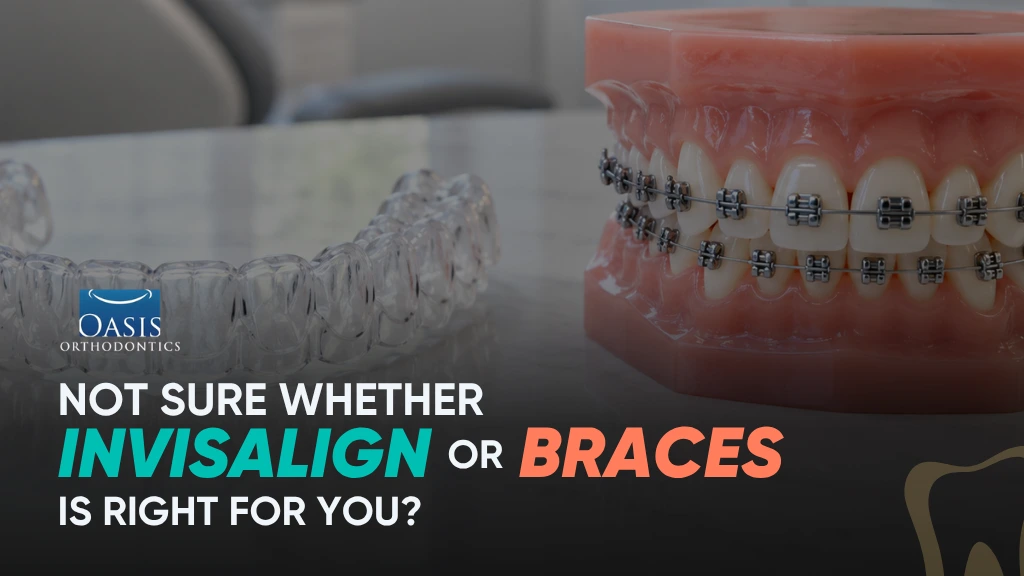
Choosing between Invisalign and braces is not really about preference. It comes down to what your teeth and bite actually require, and whether the option you are considering can deliver that reliably.
Some cases work well with either. Others have a clear answer, and knowing which category your case falls into before you sit down with an orthodontist makes that conversation a lot more useful.
How Each Option Moves Teeth
Both Invisalign and braces work through the same biological process. Controlled pressure is applied to a tooth, the bone surrounding it gradually remodels in response, and the tooth shifts into a new position over time. What differs is how that pressure is applied and maintained.
Braces apply force through brackets bonded directly to each tooth and connected by an archwire. The force is continuous and does not depend on anything the patient does between appointments. Because the brackets are fixed to the tooth surface, the orthodontist has direct mechanical control over the direction and magnitude of force on each individual tooth throughout treatment.
Invisalign uses a series of custom-made clear plastic trays, each designed to move teeth a small increment toward the next planned position. Patients switch to a new tray roughly every one to two weeks. The trays must be worn 20 to 22 hours each day for the planned movement to occur. Force is applied only while the tray is in the mouth, which means the result depends directly on how consistently the patient wears it.
Where Invisalign Works Well
Mild to moderate crowding, spacing between teeth, and certain bite issues respond well to clear aligner treatment. For adults and older teenagers with alignment concerns in that range and consistent daily habits, Invisalign is a clinically sound option. Removing the aligners for eating, brushing, and flossing makes oral hygiene during treatment significantly easier than working around fixed brackets and wires.
For teens considering Invisalign, the same clinical range applies, though the compliance requirement becomes a more significant factor. Invisalign Teen includes compliance indicators to track wear consistency, but the outcome still depends on daily habits.
Invisalign has also expanded its range through attachments: small tooth-colored composite shapes bonded to specific teeth to give the tray more grip and allow more complex movements. When part of the plan, they extend what clear aligners can reliably achieve.
Where Braces Have a Clinical Advantage
Certain types of tooth movement are more reliably achieved with fixed braces.
Significant rotations. Teeth that need to rotate substantially around their long axis are difficult for aligners to move predictably. Brackets give the orthodontist direct attachment to the tooth surface, which allows precise rotational control that plastic trays cannot consistently replicate.
Vertical movement. Moving teeth up or down relative to the gumline is one of the more challenging movements for clear aligners. Braces handle it more precisely because the archwire can be bent to apply vertical force directly.
Complex bite corrections. Significant overbites, underbites, and skeletal discrepancies often require coordinated movement across both arches with sustained, directional force over a long period. Fixed metal braces or clear braces give the orthodontist greater mechanical control for these corrections. The common treatments page covers the full range of what each appliance addresses.
Severe crowding. Cases involving significant overlap or extractions to create space often proceed more predictably with braces.
Cases where daily compliance cannot be relied upon. Braces apply force continuously because they cannot be removed. For younger patients or anyone for whom consistent 20 to 22 hour daily wear is realistically difficult, fixed appliances remove the compliance variable entirely.
The Compliance Factor
Invisalign results depend directly on how consistently patients wear their aligners. When trays are worn for fewer hours than directed, planned movements do not complete, teeth can drift back between wearing periods, and treatment extends. In some cases, refinement trays are needed to close the gap between where the teeth ended up and where the plan said they should be.
For patients who wear aligners as directed, the results are excellent. For patients who find consistent wear difficult because of their work, routine, or habits, braces produce more predictable outcomes because the treatment does not depend on patient behavior between appointments.
Being clear-eyed about this before choosing is more useful than picking based on appearance and hoping the habit follows.
Which Patient Profile Fits Which Option
Invisalign tends to be the stronger fit when: the case involves mild to moderate crowding, spacing, or bite issues within the aligner’s clinical range; the patient is an adult or older teenager with consistent daily habits; appearance during treatment is a practical concern; and oral hygiene habits are well established.
Braces tend to be the stronger fit when: the case involves significant bite correction, severe crowding, complex rotations, or vertical tooth movements; the patient is a younger teenager whose compliance habits favor fixed appliances; or the patient is involved in contact sports where removing aligners creates problems.
When either option could work: many moderate cases sit within the clinical range of both. When the orthodontics do not make the decision for you, the choice comes down to how you live and what your orthodontist recommends after reviewing your clinical picture.
Frequently Asked Questions
Is Invisalign as effective as braces?
Yes, for cases within its clinical range. Mild to moderate crowding, spacing, and many bite issues respond well to Invisalign when treatment is planned and supervised by an orthodontic specialist. For complex bite corrections, significant rotations, or severe crowding, braces typically give the orthodontist greater mechanical control.
Can Invisalign fix an overbite or underbite?
Sometimes, yes. Mild to moderate dental overbites and underbites, where the issue is primarily tooth position rather than jaw structure, can often be corrected with Invisalign. Significant skeletal discrepancies are more reliably corrected with braces and may in some cases require surgical coordination.
Do braces work faster than Invisalign?
Not as a general rule. For equivalent cases, treatment timelines are broadly similar. For complex corrections involving movements that braces handle more precisely, braces may be more efficient. For mild to moderate cases where Invisalign is a strong fit, timelines are comparable when aligners are worn consistently.
What happens if I do not wear my Invisalign aligners enough?
Teeth do not complete their planned movement and may drift back between wearing periods. This can extend treatment, require additional refinement trays, or result in a finish position that does not match the original plan. Consistent 20 to 22 hour daily wear is what produces the result the treatment was planned to achieve.
Can adults get braces?
Yes, without any limitation. Braces are equally effective in adult patients. Adult bone is denser than adolescent bone, which can mean teeth respond slightly more slowly to orthodontic force, but the quality of results is not affected by age.
How do I know which option is right for my case?
No comparison can tell you, and that includes this one. The degree of tooth movement needed, the direction of that movement, and how your bite is structured are what determine the answer. A clinical assessment with X-rays and detailed examination, done by an orthodontic specialist, will give you the answer that actually applies to your case.
Before You Decide
Two patients with what looks like the same problem can end up with different recommendations, and both can be right.
If you are in the Markham area and want a clear answer for your specific case, Oasis Orthodontics is where Dr. Khushee Sharma-Fung sees every patient personally and reviews the full clinical picture before any recommendation is made. No rotated providers, no delegated assessments.