
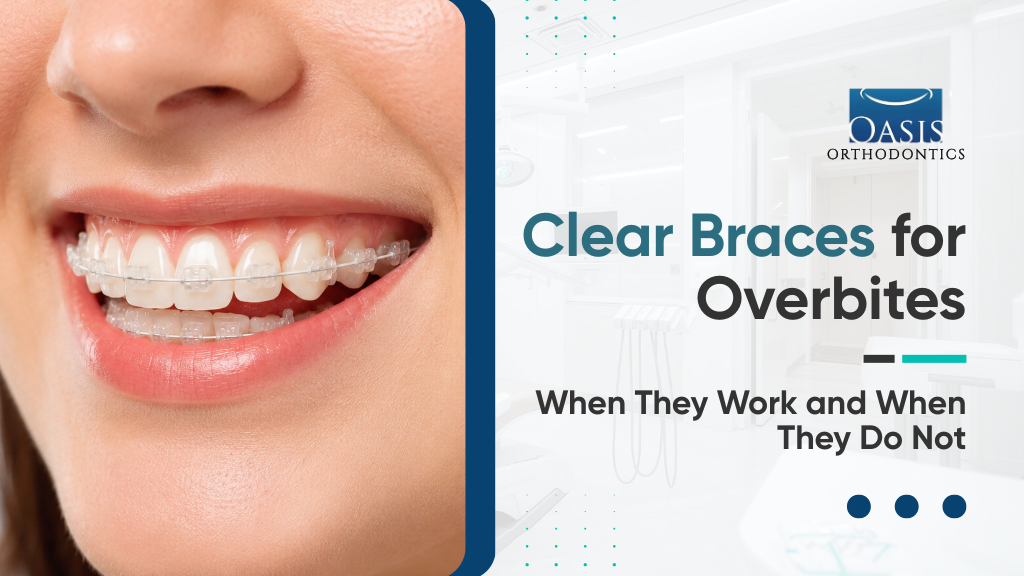
Many patients asking about clear braces have an overbite and want to know whether a discreet fixed appliance can actually fix it, or whether metal braces are the only option that works.
For mild to moderate dental overbites, clear ceramic braces correct the bite just as effectively as metal braces. The same tooth-colored bracket-and-wire system that addresses crowding and spacing works for bite correction too, usually with elastics added to reposition how the upper and lower teeth meet. Severe skeletal overbites, where the jaw structure itself is the underlying cause, require more than clear braces alone can provide. For most patients seeking a discreet option, clear braces are a clinically sound choice provided the case falls within their range.
What an Overbite Actually Is
An overbite occurs when the upper front teeth overlap the lower front teeth more than they should. Some vertical overlap is normal, typically a few millimetres. When that overlap becomes excessive, covering a significant portion of the lower teeth, it affects bite function, places uneven pressure on teeth, and can cause long-term enamel wear.
Two distinct causes produce what looks like the same problem from the outside.
A dental overbite is a tooth positioning issue. Teeth have grown in at incorrect angles, or back teeth have been lost, causing the bite to collapse. The jaw relationship is relatively normal. The problem lives in how the teeth sit, not in the underlying bone structure. Dental overbites respond well to braces and respond particularly well to clear ceramic braces for patients who prioritise discretion during treatment.
A skeletal overbite involves the jaw bones themselves. The lower jaw is shorter relative to the upper jaw, pushing the front teeth into an excessive overlap driven by bone structure rather than tooth position. Mild skeletal cases in growing patients can still be managed effectively with braces and elastics. Severe skeletal overbites in adults, where the jaw discrepancy is substantial, may require surgical orthodontics alongside braces for complete correction.
Most overbite cases involve a combination of both components. A clinical evaluation with X-rays and bite measurements determines which factor is driving the problem and what approach will address it effectively.
How Clear Braces Correct an Overbite
Clear braces use tooth-colored ceramic brackets bonded to each tooth, connected by a wire that applies controlled force to move teeth gradually over time. The mechanism is identical to metal braces. The difference is the material, which is designed to blend with the natural shade of teeth rather than contrast against them.
For overbite correction specifically, the wire and bracket system repositions upper and lower front teeth to reduce the vertical overlap. Most overbite cases also involve Class II elastics, small rubber bands that typically hook from the upper back teeth to the lower front teeth. The elastics apply force that encourages the lower jaw to come forward while holding back the upper teeth, progressively improving the bite relationship over the course of treatment.
The addition of elastics does not change the visual advantage of clear braces. Elastics are changed daily and the brackets themselves remain tooth-colored throughout treatment.
When Clear Braces Are the Right Choice for an Overbite
Clear ceramic braces work well for overbite correction in several situations. Adults and older teenagers with mild to moderate dental overbites are strong candidates. The bite correction mechanism with clear braces is equivalent to metal braces for cases within this range. Patients who spend significant time in professional environments, client-facing roles, or settings where appearance matters consistently throughout an 18 to 24 month treatment often find the discreet bracket profile worth prioritising.
Patients with mixed dental and skeletal components at the mild to moderate end of the spectrum can also benefit from clear braces. These cases require careful treatment planning, but they fall within the clinical range where ceramic brackets perform as effectively as metal.
Teenagers who are image-conscious and have overbites in the moderate range are candidates too, though the added care requirements of ceramic brackets, avoiding certain foods, maintaining diligent oral hygiene, require consistent habits throughout treatment.
Treatment Duration for Overbite Cases
Treatment time for overbite correction with clear braces typically runs 18 to 24 months for most dental and mild skeletal cases. Mild overbites with primarily dental causes can sometimes resolve in 12 to 18 months. Complex cases, particularly those with significant skeletal components, may run longer.
Two factors within the patient’s control have the greatest effect on staying on schedule.
Elastic wear is the most significant. Elastics for bite correction need to be worn 20 to 22 hours per day. Removing them more than necessary does not just pause progress, it actively allows teeth to drift back toward their previous positions. Inconsistent elastic wear is one of the most common reasons overbite treatment extends beyond the original projected timeline.
Protecting ceramic brackets from damage also matters. Hard and sticky foods risk chipping ceramic brackets. A broken bracket stops movement on that tooth until repaired, and repeated breakages accumulate into meaningful delays across the full course of treatment.
Frequently Asked Questions
Can clear braces fully correct an overbite? For mild to moderate dental overbites, yes. Clear ceramic braces apply the same corrective force as metal braces and achieve equivalent results for cases within their clinical range. Severe skeletal overbites may require additional treatment beyond braces alone.
Do you need elastics with clear braces for an overbite? In most overbite cases, yes. Elastics apply the force needed to correct the bite relationship between upper and lower teeth. They are used with both clear and metal braces for overbite correction and need to be worn consistently to keep treatment on schedule.
How long do clear braces take to fix an overbite? Most cases run 18 to 24 months. Mild dental overbites may finish in 12 to 18 months. Complex cases with skeletal components can take longer depending on the degree of correction required.
Are clear braces as effective as metal for overbite correction? For dental and mild to moderate overbite cases, yes. The corrective mechanism is identical. Metal braces maintain a slight advantage for cases requiring very heavy sustained force or significant vertical movement, but for most patients seeking overbite correction, clear braces deliver equivalent results.
Will an untreated overbite cause problems? A significant overbite places uneven pressure on the front teeth, which can cause enamel wear, chipping, and increased sensitivity over time. Correcting the bite distributes chewing force more evenly and reduces the long-term risk of tooth damage.
Get a Clear Answer for Your Overbite
Whether clear braces are right for your overbite depends on your specific bite, the severity of the overlap, and whether the cause is dental, skeletal, or a combination of both. General guidance gives you a useful starting point. A clinical evaluation gives you the actual answer for your case.
At Oasis Orthodontics in Markham, Dr. Khushee Sharma-Fung personally assesses every patient, reviews bite structure and jaw relationship, and gives a clear recommendation on whether clear braces are the right approach for your overbite. Book your consultation and know exactly what your treatment involves before you commit.