
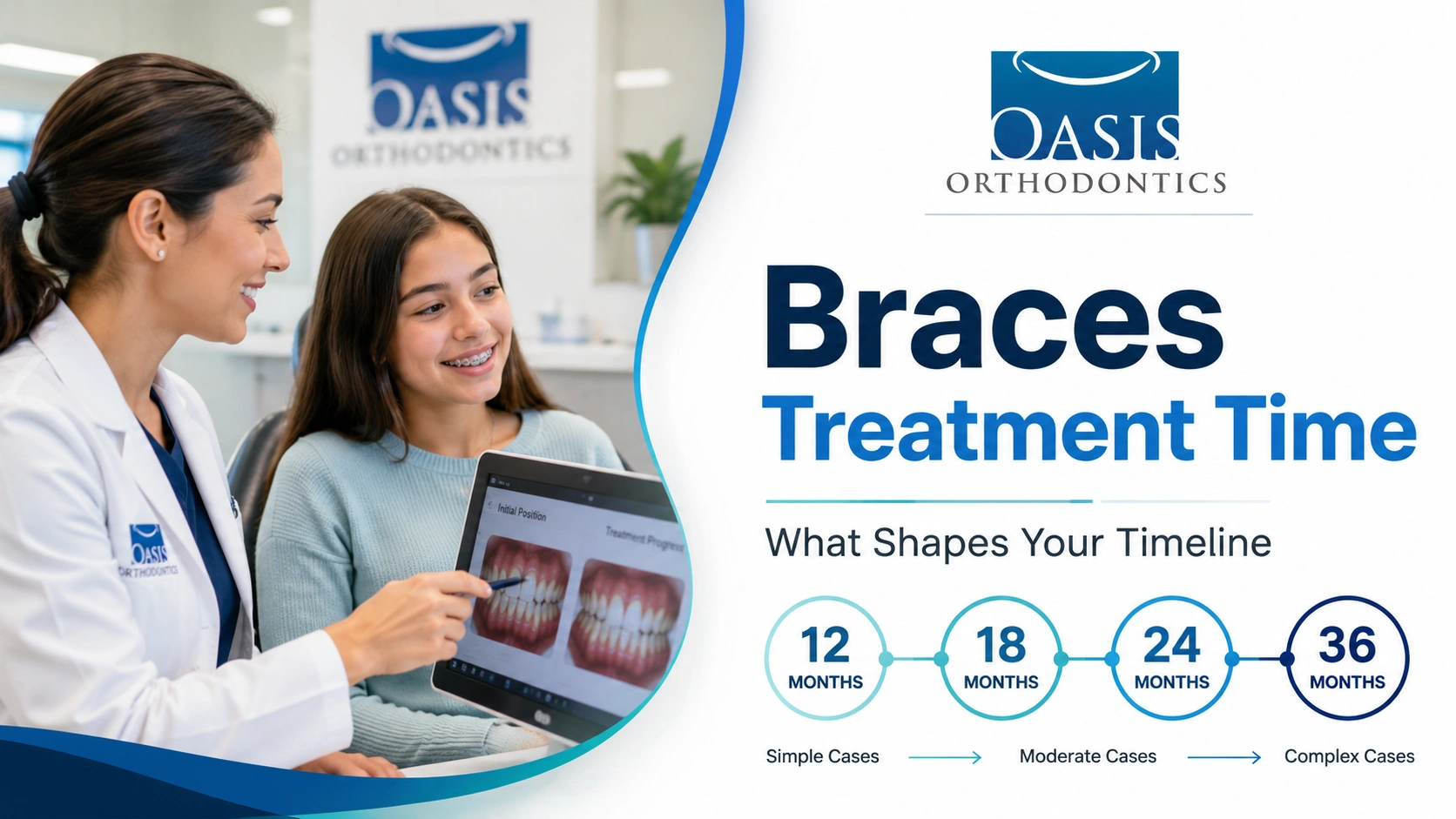
Most patients expect a clear number when they ask about braces. The honest answer is that treatment takes anywhere from 12 months for simple cases to 36 months for complex ones, and several things sit between you and your finish date that are worth understanding before you start.
For most people, braces stay on for 18 to 24 months. What puts you closer to 12 or closer to 30 comes down to what your teeth need, how your body responds, and what you do consistently throughout treatment. Patients who protect their brackets, attend every appointment, and follow their orthodontist’s instructions reliably finish on time. Those who do not almost always add months they did not plan for.
What follows breaks down each factor honestly so you know exactly what you are dealing with before treatment begins.
The Complexity of Your Case Sets the Baseline
Before anything else, the nature of the problem being corrected establishes your starting range.
Mild cases involve minor crowding, small gaps, or slight rotations where most teeth are already close to their target positions. Patients in this category typically finish within 12 months.
Moderate cases are the most common across orthodontic practices. Noticeable crowding, several rotated teeth, a mild overbite, or an underbite fall here. Treatment runs 18 to 24 months for most patients in this group.
Complex cases involve significant bite problems, jaw discrepancies, or overlapping issues across multiple areas of the mouth. These take 24 to 30 months. Patients whose plan includes surgical orthodontics should account for a total window of 24 to 36 months, covering pre-surgical braces, the procedure itself, healing time, and post-surgical finishing.
Why Age Matters More Than Most Patients Realize
Jaws are still developing in children and teenagers, which means teeth respond to orthodontic force with less resistance. Adults achieve equally good outcomes, though treatment can run slightly longer because mature bone has greater density.
For straightforward cases, the age-related difference is usually weeks rather than months. For complex bite corrections, the gap can be more meaningful and worth factoring into your expectations from the start.
Children who show signs of developing problems early may be candidates for two-phase treatment, where a first phase of targeted intervention during growth is followed by comprehensive braces in the teen years. Phase One typically runs 12 to 18 months. Phase Two is often shorter and less involved because the structural groundwork was already done.
The Habits That Either Protect or Extend Your Timeline
Case complexity is largely fixed. How you behave during treatment is not. Most treatment overruns come from a small number of preventable causes.
Missing adjustment appointments is the single most controllable delay. Appointments happen every four to eight weeks, and each one advances the treatment plan. Skipping one means a full cycle of planned movement does not happen. A handful of missed visits across two years adds months.
Inconsistent elastic wear is the other major cause. Elastics correct bite relationships and work only when worn as directed. Patients correcting overbites or underbites who remove their elastics regularly are essentially pausing that part of their treatment every time they do.
Broken brackets stop movement on the affected tooth until the bracket is repaired. When breaks happen between appointments, that tooth makes no progress for days or sometimes weeks. Repeated breakages accumulate into real delays. The food restrictions that come with metal braces and clear braces protect the hardware doing the work, and by extension, your finish date.
Oral health problems during treatment can pause orthodontic progress entirely. A cavity or gum disease requires the issue to be treated before movement on the affected area can safely continue. Consistent brushing and flossing protect both the teeth and the timeline.
How Different Treatment Options Compare
Metal braces and ceramic clear braces operate on the same mechanical principles. Bracket material does not change how quickly teeth respond to force, so treatment times are comparable for equivalent cases.
Ceramic braces are tooth-colored and blend with the teeth, which many patients prefer. Duration mirrors metal braces in most cases, though ceramic brackets need more careful maintenance to avoid breakage.
Invisalign moves teeth through a series of custom removable trays changed at regular intervals. For mild to moderate cases, total treatment time is broadly similar to braces, provided aligners are worn for the required 20 to 22 hours per day. Every hour they are out is an hour they are not working.
For complex bite corrections, traditional braces tend to be more efficient. Continuous bracket-and-wire force handles certain movements, particularly vertical shifts and significant rotations, more precisely than removable trays.
What Happens After Braces Come Off
Treatment does not end on the day braces are removed. Teeth need time to stabilize in their new positions while surrounding bone and tissue settle around them. Retainers hold everything in place during that window.
Most patients wear retainers full-time for the first few months, then shift to nighttime wear long-term. Skipping retainer wear is one of the most common reasons patients see their teeth drift back after treatment ends. Retention is a permanent commitment for most people, not a short-term step.
Common Questions About Treatment Duration
Can braces be finished in 12 months? For mild cases involving minor crowding or small spacing issues, yes. A proper clinical evaluation determines whether your situation falls within that range.
Do braces take longer for adults? Adults typically take a little longer for comparable cases because mature bone responds more slowly to orthodontic force. For mild to moderate cases the difference is usually small. For complex corrections the gap is more noticeable.
What causes treatment to run longer than estimated? Missed appointments, inconsistent elastic wear, broken brackets from eating restricted foods, and oral health problems that require pausing treatment. Most delays come from factors within the patient’s control.
How long does overbite correction take? Mild overbites often correct within the standard 18 to 24 month window. Moderate to severe overbites frequently take 24 months or longer, particularly when jaw repositioning is involved.
How long does treatment take for crowded teeth? Mild to moderate crowding typically resolves in 12 to 24 months. Severe crowding requiring extractions or significant arch expansion can extend past 24 months depending on how much space needs creating.
How long does crossbite correction take? Dental crossbites in growing patients can sometimes resolve in under 12 months with an expander. Skeletal crossbites or those in adults take longer and usually require additional appliances alongside braces.
Find Out Exactly How Long Your Treatment Will Take
General timelines tell you what happens across a broad range of patients. Your number comes from your specific teeth, bite, and dental history, and no estimate is worth anything without a proper clinical evaluation behind it.
At Oasis Orthodontics in Markham, Dr. Khushee Sharma-Fung personally reviews every case, takes clinical measurements, and gives you a clear, realistic timeline based on what she actually sees, not a rough average. Book a consultation and leave with a treatment plan and a timeline that belongs to you.